Rent you can defend
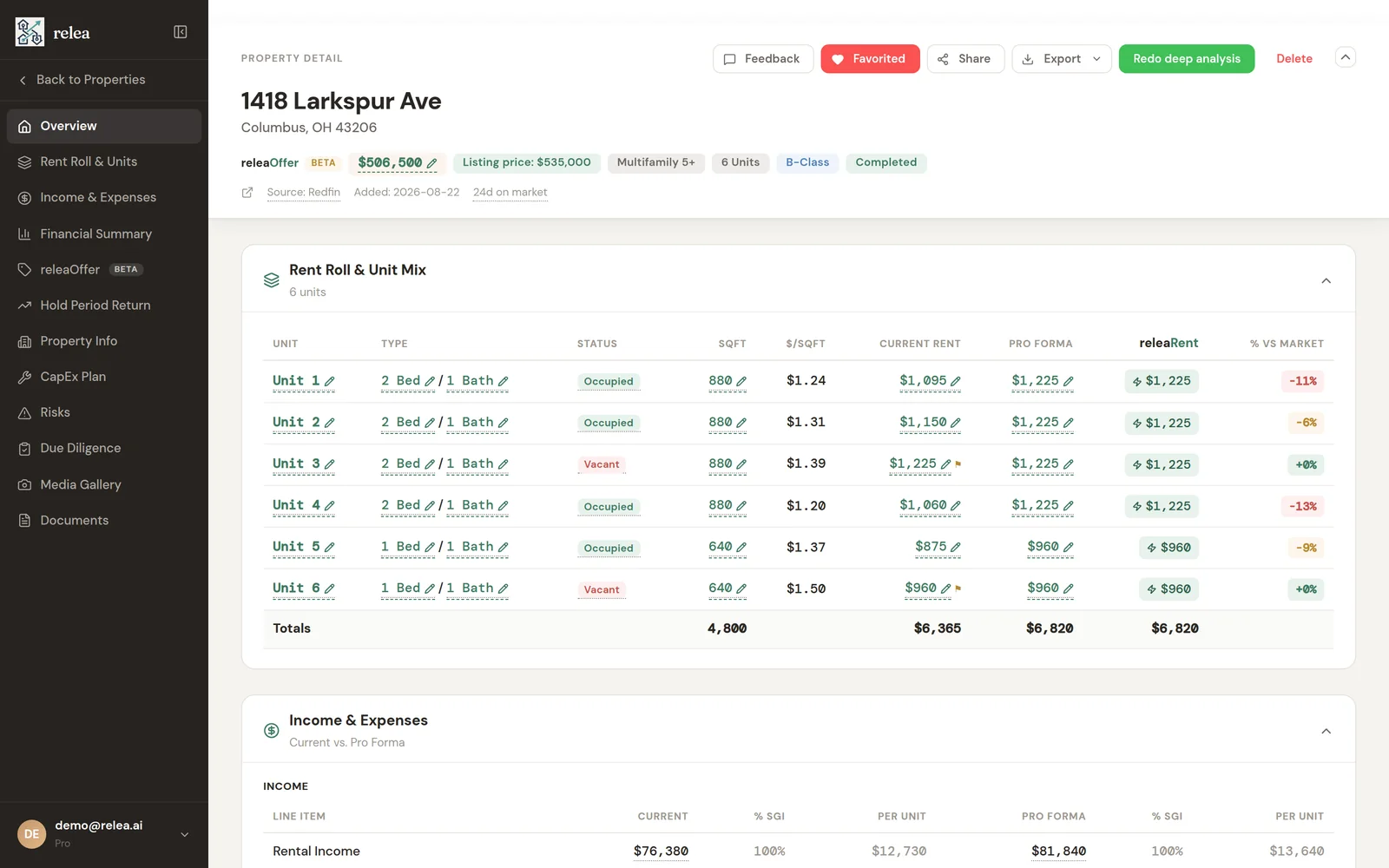
releaRent prices each unit type as a range from live rental listings, with the comps on the page.
Free calculator, no account
Project cash flow, paydown and the sale to get total ROI, annualized ROI, IRR and equity multiple, pre-tax, year by year.
The purchase
The hold and the sale
Example values. Change any of them. Pre-tax: no depreciation or income tax. Estimates from the numbers you entered, not a forecast or investment advice.
Five-year math magnifies what you put in for year one. On a real listing relea starts from sourced rent, taxes at your purchase price and CapEx by urgency, so year one comes from sources, not guesses.
Run it on a real listing →3 listings free. Sign up with Google or email. No card.
| Year | NOI | Loan payments | Cash flow |
|---|---|---|---|
| 1 | $38,304 | $35,926 | $2,378 |
| 2 | $39,453 | $35,926 | $3,527 |
| 3 | $40,637 | $35,926 | $4,710 |
| 4 | $41,856 | $35,926 | $5,929 |
| 5 | $43,111 | $35,926 | $7,185 |
On a real listing
Every number on a relea listing shows its source. Built by a 20-year, multi-state operator: conservative by default, and every assumption can be overridden.
releaRent prices each unit type as a range from live rental listings, with the comps on the page.
The seller's tax bill resets when you buy. relea recalculates it at your purchase price.
A 1968 roof is a number, not a footnote; relea prices repairs by urgency from the building's age and condition.
The math
A rental property makes you money in four ways over the hold: annual cash flow, the principal paid down on the mortgage, the appreciation when you sell, minus the cost of buying and selling it. The calculator projects the cash flow each year, sells the property at the end of the hold and sums it up.
The sample takes a $168,000 investment (25% down and 3% closing costs) and assumes 3% rent growth and 3% appreciation. It sells after five years with 6% selling costs. Cash flow starts at $2,378 and grows to $7,185, because the rent rises while the mortgage payment stays the same, for $23,729 in total. The property sells for $695,564, the mortgage is paid down to $423,592, and the sale nets $230,238.
| Where the profit comes from | Amount |
|---|---|
| Cash flow, years 1 to 5 | $23,729 |
| Loan paydown ($450,000 to $423,592) | $26,408 |
| Value change after 6% selling costs | $53,831 |
| Purchase closing costs | -$18,000 |
| Total profit | $85,968 |
That gives a total ROI of 51.2% on the $168,000. Annualized it is 8.6%, the IRR is 8.9% and the equity multiple is 1.51x. Less than a third of the profit is cash flow; most of the return comes from the sale, which is the least certain number in the model.
Cash-on-cash is the return in year one only: 1.4% for the sample. Total ROI is the return over the full hold, without regard to when it comes back. Annualized ROI spreads that total evenly across the years. IRR also accounts for timing and rewards money that comes back earlier, so two deals can have the same total ROI and different IRRs. Equity multiple is how many times your money comes back, also without regard to timing.
Reading the result
Three inputs move the answer most. The sale value: a single point of annual appreciation (2% instead of 3%) moves the sample's IRR from 8.9% down to 6.0%. The interest rate, which sets both cash flow and paydown. And rent growth, which compounds every year of the hold. To see how much a deal hinges on each, change them one at a time.
Questions
After your 3 free listings, pay as you go for as low as $3 per listing, or subscribe: Plus is $49 a month for 25 listings (about $1.96 per listing) and Pro is $149 a month for 150 (about $0.99 per listing). See plans
There is no single “good” ROI. It depends on financing, the market, the risk and what else you could do with the money. Compare IRRs over the same hold and assumptions, and check how much of the return comes from the sale.
ROI is the total return over the hold (profit divided by cash invested), without regard to timing. IRR is the yearly rate of return that accounts for when the cash comes back; earlier cash is worth more.
No, this calculator is pre-tax. Depreciation, income tax and tax on the sale depend on your situation, so ask your tax advisor.
For small rentals, a yearly appreciation rate is more intuitive and closer to how these properties trade. For larger multifamily, an exit cap rate on the final year’s NOI is the usual method, and an exit cap option may follow.
The total cash you get back (cash flow plus net sale proceeds) divided by the cash you put in. For the sample, $253,968 back on $168,000 invested is 1.51x.
Same fourplex, next question
All of these calculators open on the same sample fourplex, so you can carry one deal from one question to the next.
Three deals free. No card. relea builds the full model with sourced rent, taxes and CapEx.
Questions? support@relea.ai. We reply within one business day.