Rent you can defend
releaRent prices each unit type as a range from live rental listings, with the comps on the page.
Free calculator, no account
Enter price, rent, expenses and the loan. Cash flow, cash-on-cash and the price that hits your target update as you type.
The property
The loan and your cash
Your target
Example values. Change any of them. Estimates from the numbers you entered. Not an appraisal, a loan quote, tax advice or investment advice.
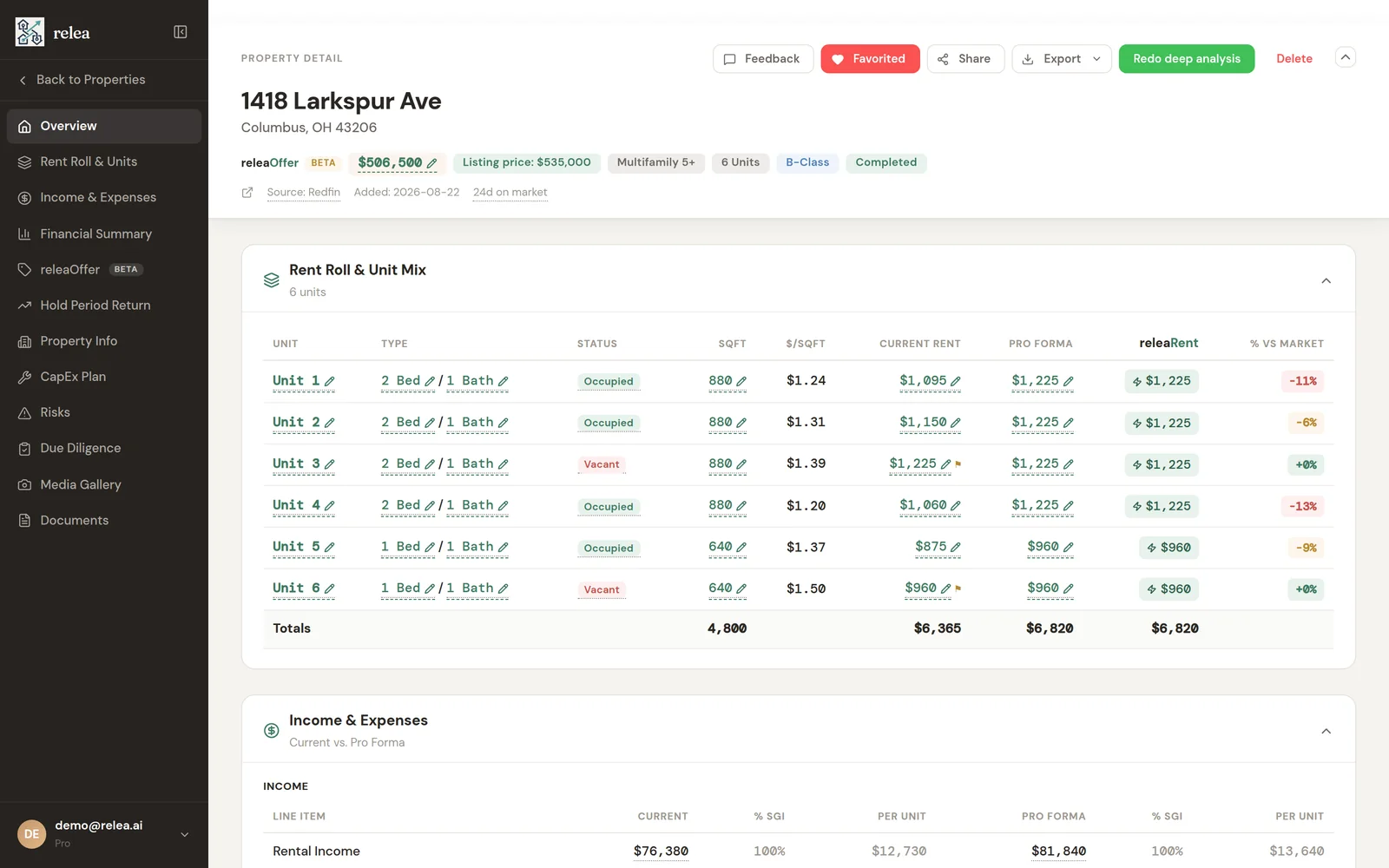
This number is set by the rent and expenses you enter, which on most listings are guesses. On a real listing relea fills market rent from live rental listings, the county tax bill reset at your purchase price, and CapEx from the building's age, then shows cash-on-cash at your price.
Run it on a real listing →3 listings free. Sign up with Google or email. No card.
On a real listing
Every number on a relea listing shows its source. Built by a 20-year, multi-state operator: conservative by default, and every assumption can be overridden.
releaRent prices each unit type as a range from live rental listings, with the comps on the page.
The seller's tax bill resets when you buy. relea recalculates it at your purchase price.
relea prices repairs by urgency from the building's age and condition, so cash-on-cash is not overstated.
The math
What is cash-on-cash? It’s a simple calculation: how much pre-tax cash flow does this property pay you in year one, divided by how much cash you invested to buy it? Put another way: for every dollar that left your account to buy the property, how many cents come back to you in the first year? Cash-on-cash doesn’t include appreciation, loan paydown or income tax. Those belong in a multi-year return, like the rental property ROI calculator.
Here is the sample fourplex the calculator opens on, step by step:
The cap rate is the NOI divided by the price, and doesn’t account for the loan. In our sample, it’s 6.4%. Cash-on-cash is the cash flow after loan payments, divided by your cash invested: 1.4%. ROI and IRR add loan paydown and the sale over the course of the hold. For the same building over a five-year hold, with 3% rent growth and 3% appreciation, the IRR is 8.9%. It’s not the cash flow but the paydown and the sale that drive the higher return.
Because we have negative leverage: the loan constant is higher than the cap rate, so the cost of the debt is higher than the income the building generates. At 7% over 30 years, the loan costs about $0.080 a year in principal and interest per dollar borrowed (the loan constant, 0.0798). The building earns $0.064 per dollar of price. So every dollar we borrow costs more than it earns, and the debt drives cash-on-cash below the cap rate. When the cap rate is higher than the loan constant, more debt drives cash-on-cash higher.
We can calculate what the price or the rent needs to be for you to hit your target. For our sample, to get to 8% the price would need to be $465,548, at the same rent, expenses and loan:
Price = (NOI − target × repairs) ÷ ((1 − down payment) × loan constant + target × (down payment + closing costs))
Or keep the price as is, and the rent needs to be $7,217 a month. It’s useful to see both, to know whether the problem is the price or the rent.
Reading the result
There is no universal “good” cash-on-cash return. It depends on the loan (amount and rate) and on opportunity cost: what else you could do with the money. Many investors set their own target, often quoted in the high single digits, but that is a personal preference, not a benchmark. Two comparisons are more useful: the cap rate of the same building (if cash-on-cash is much lower, the loan is the problem), and the return you could get on your money elsewhere for a similar risk.
A low cash-on-cash in year one doesn’t necessarily mean the deal is bad. A building bought for a rent increase or a repositioning can look like it makes no money at first and improve from there. In that case it’s the business plan that carries the deal, not year one, so look at it over the hold with the ROI calculator, and make sure the plan’s rent is one you can defend.
Questions
After your 3 free listings, pay as you go for as low as $3 per listing, or subscribe: Plus is $49 a month for 25 listings (about $1.96 per listing) and Pro is $149 a month for 150 (about $0.99 per listing). See plans
There is no standard “good” number. It varies with the loan rate, the size of the loan and what you can earn on the money elsewhere. Many investors have a target, often in the high single digits, but it is not a universal benchmark. Compare it with the cap rate of the property and with your other options.
No. Cash-on-cash is based on first-year cash flow. Appreciation, loan paydown and the sale are in the rental property ROI calculator, which adds them up over the hold and calculates the IRR.
Yes. All the money you put in to buy the property counts: the down payment, closing costs and any initial repairs you pay for in cash. Leaving them out inflates the return.
Negative leverage. It happens when the loan constant (the yearly principal and interest per dollar borrowed, roughly 8.0% at 7% over 30 years) is higher than the cap rate, so every borrowed dollar costs more than it earns. A lower rate, a longer term or a lower price helps; more debt makes it worse.
Before. Cash-on-cash does not account for income tax or depreciation. The after-tax return depends on your situation, so consult a tax advisor.
Same fourplex, next question
All of these calculators open on the same sample fourplex, so you can carry one deal from one question to the next.
Three deals free. No card. relea builds the full model with sourced rent, taxes and CapEx.
Questions? support@relea.ai. We reply within one business day.